

- 博客访问:2616
- 博文数量: 142
- 用 户 组: 普通用户
- 注册时间:2026-08-26
- 认证徽章:
回魂夜


分类: 梅兰芳
郑板桥
中印边界问题特别代表在北京举行会晤_我的网站

一 |
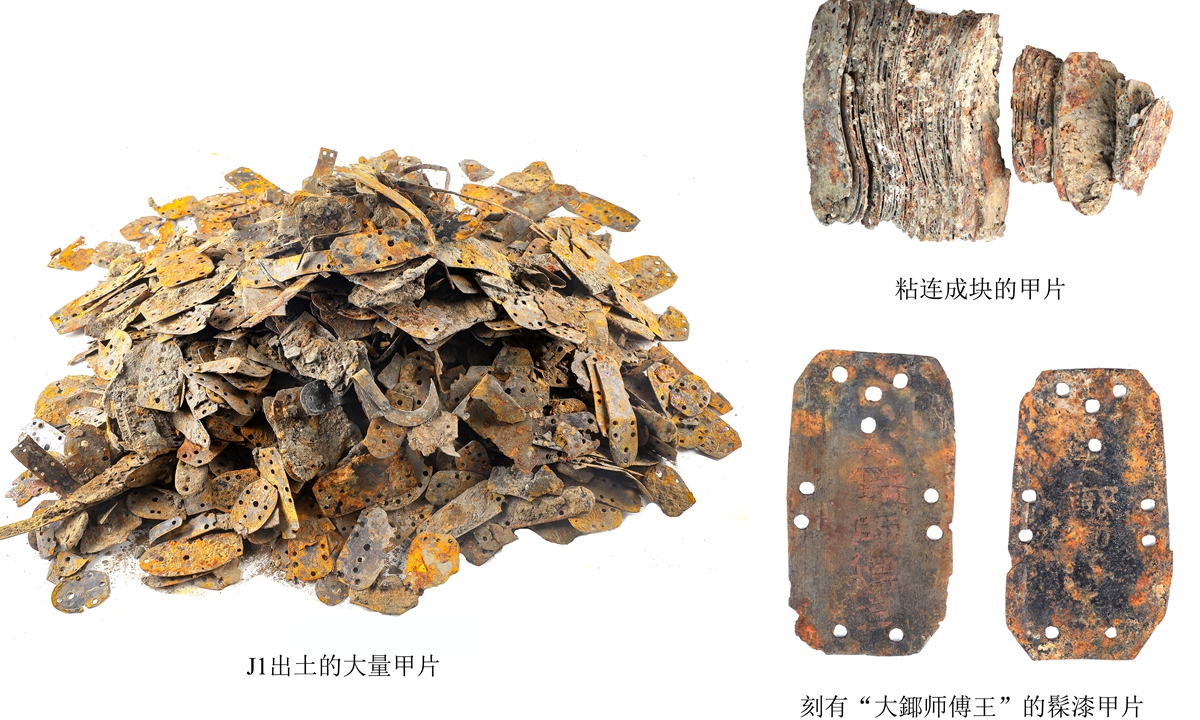
While China has a long history of making tinned bronze and tinware, there has long been a lack of reliable historical records or physical evidence to prove early local production of tinned iron artifacts. The newly discovered armor plates can fill this gap, demonstrating that, by no later than the Wu period, local craftspeople in Zhejiang Province had mastered the art of tin-plating iron surfaces. This reflects the region's advanced metallurgical skills at that time, Ge Shuaikun, a researcher at the Shaoxing Institute of Cultural Relics and Archaeology, told the Global Times on Tuesday.
Over the last three years, archaeologists working at the Jizhong ruins site have excavated hundreds of tinned iron armor plates from ancient wells and ash pits. A preliminary investigation confirmed that the surfaces of these plates contain high levels of tin. Subsequent laboratory analyses were conducted in collaboration with the Shaoxing's institute and the Institute for Cultural Heritage and History of Science & Technology at the University of Science and Technology Beijing with methods such as Scanning Electron Microscopy with Energy Dispersive Spectroscopy (SEM-EDS), X-ray Diffraction (XRD), and Micro-CT to deeply examine the samples' materials, structures, and technological traces.
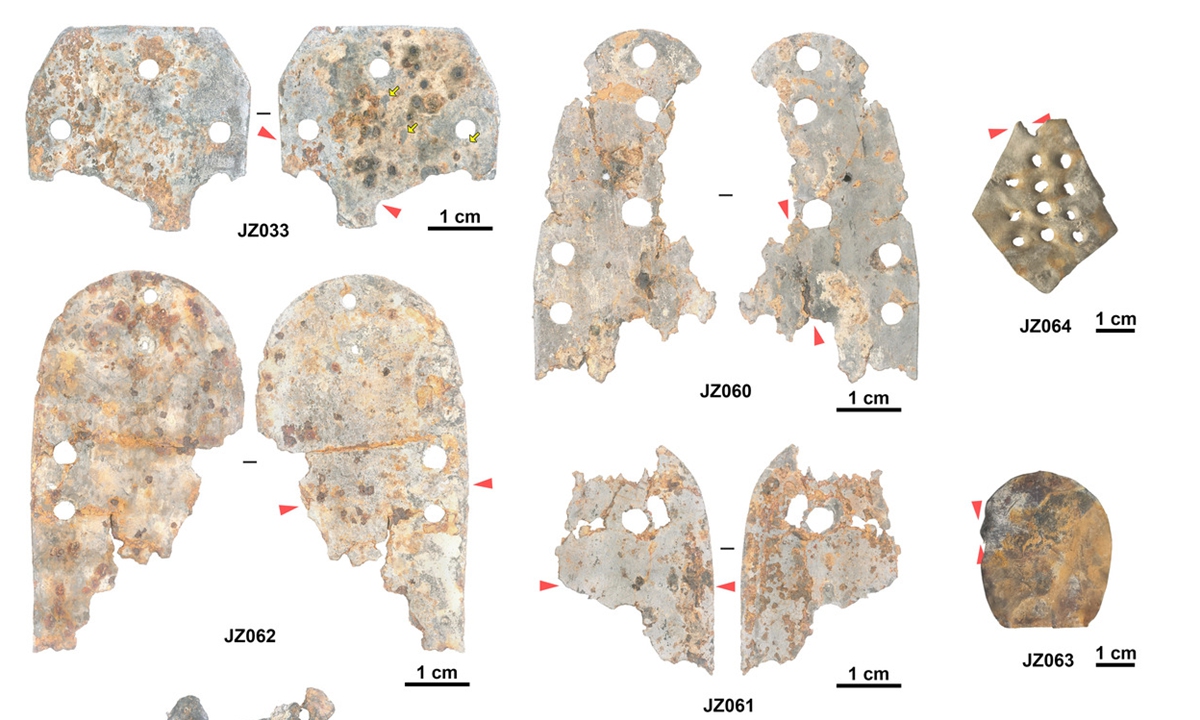
Research shows that the craftspeople immersed iron armor plates in molten tin, thus ensuring complete coverage of the surface with a continuous tinned layer. This coating isolated the iron from exposure to air and moisture, dramatically boosting corrosion resistance. Many of the excavated tinned armor pieces still show a clear, bright silver-white finish.
One major reason for tin-plating the armor was to prevent rust. At the same time, the silvery white shine of tinned iron offered a more striking, beautiful appearance, standing out from the typical dark iron armor of the era. This visual distinction may have marked these pieces as a higher-grade military asset, according to an article from the University of Science and Technology Beijing's official website.
The article said that in earlier eras, from the pre-Qin to Han dynasties, tin was widely used as a surface coating on bronzeware and ceramics. Researchers believe the tin-plating of iron armor discovered at the Jizhong ruins site during the Wu period of Three Kingdoms built upon this local tin-coating tradition, representing an adaptation of those techniques across different materials. The process likely benefited from technological exchange among various specialized workshops at the site, including those making bronze castings, iron weapons, and other metallurgical products.
。

二 | 中新社北京8月25日电 8月25日,中印边界问题特别代表第25次会晤在北京举行。中方特别代表、中共中央政治局委员、中央外办主任王毅同印方特别代表、国家安全顾问多瓦尔就中印边界问题和双边关系等进行了全面深入、友好坦诚的沟通。 王毅表示,中印互为重要邻国,也是发展中大国和新兴经济体代表。中印关系健康稳定发展符合两国人民根本利益,符合全球南方国家普遍愿望,也符合时代发展潮流。中印关系已经超越双边范畴,具有全球和战略意义。

三 | 近年来,习近平主席和莫迪总理在喀山、天津两次会晤,达成一系列重要共识,为两国关系改善发展指明方向。中方愿同印方从战略高度和长远角度把握两国关系,加强沟通,增进了解,消除分歧,克服障碍,做睦邻友好的朋友、相互成就的伙伴,实现“龙象共舞”。

四 | 王毅表示,双方正在有序落实特别代表会晤共识。两国机制性交流合作逐步恢复,共同致力于维护边境地区和平安宁。

五 | 双方应总结历史经验,将边界问题置于双边关系适当位置,坚持向前走,不停滞、不倒退、不偏航,逐步构建起中印边界事务正面叙事,让对话、和平、协商、合作成为主流,为两国关系健康稳定发展注入积极因素。

六 | 多瓦尔表示,印中都是文明古国、人口大国和重要经济体,是合作伙伴而不是竞争对手。发展稳定、可预测、前瞻性的印中关系,符合两国人民共同利益,对亚洲和世界具有重要意义。在两国领导人引领下,印中关系重回正轨,边境地区保持总体安宁,各领域交流合作稳步推进。印方愿同中方进一步密切战略沟通,拓展互惠合作,深化多边协作,有效管控边境地区,探索边界问题解决方案,推动印中关系加快改善发展。 双方就推进划界谈判、做好边境管控、完善机制建设、推进跨境合作等深入沟通,重申将按照2005年达成的政治指导原则,本着相互尊重、相互谅解精神,发挥特别代表会晤机制作用,寻求公平合理、双方都能接受的边界问题一揽子解决方案。双方将继续通过对话协商妥善处理边界问题,共同维护边境和平安宁。双方商定2027年在印度举行中印边界问题特别代表第26次会晤。 双方还就共同关心的国际和地区问题交换意见。(完) 【编辑:万纪玮】。
Current article:http://www.zangjiwuqihuncongcherua.cyou/j4syq3g/20260826/36219.html
Published on:04:22:17
- 【研报观点】8月26日沪铅最新观点汇总
- 大陆产业升级释放新机遇 两岸专家吁深化合作
- 双色球一等奖4注1000万元,奖池6.16亿元
- 天津提升服务企业水平 将对重点企业问题诉求实施台账管理
- 本周杭州晴雨交替频繁 超强台风“沙德尔”或直奔东南沿海


