


新唐
China’s Pinglu Canal linking Guangxi with ASEAN completes its first full-route patrol, paving way to September opening_我的网站

一 | 绍兴8月25日电(蓝伊旎 华晟 成江喜)25日,随着最后一组隔离墩移开,历经121天全封闭集约化施工的浙江交通集团诸永高速改扩建项目诸暨北收费站杭州方向上下匝道,正式恢复通行。

二 | 作为该项目首个完成改造的收费站,其顺利通车也标志着诸永改扩建工程收费站改造取得阶段性突破。
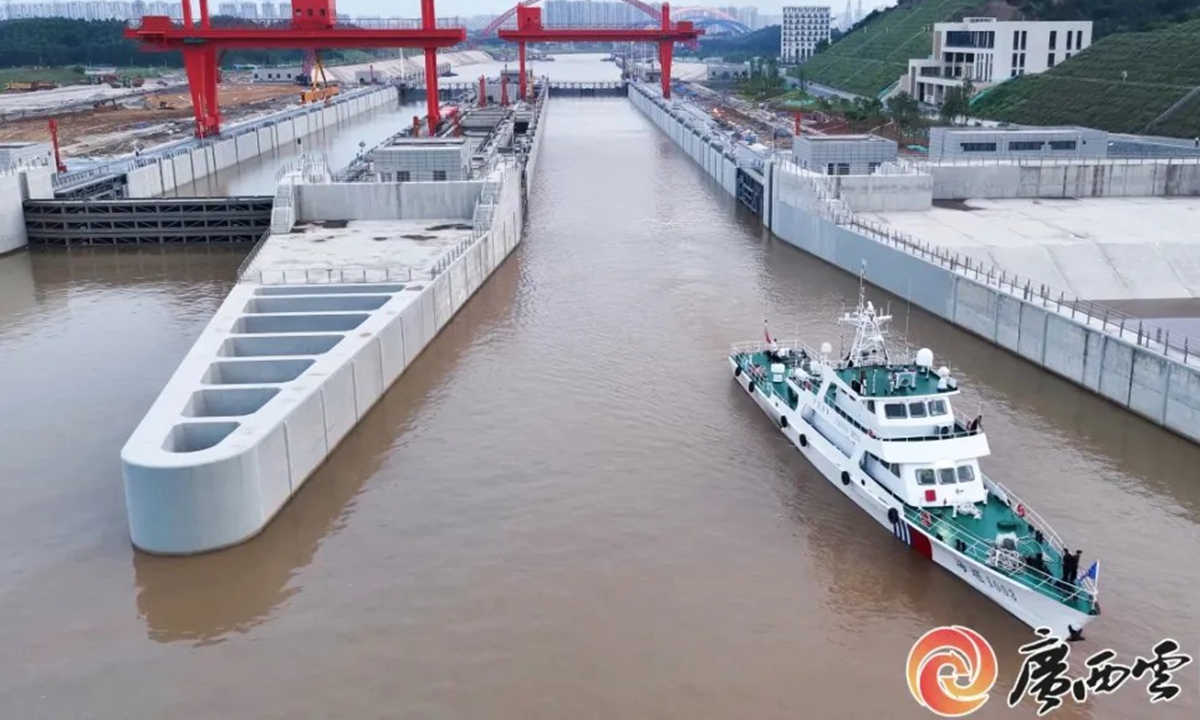
The inspection was carried out from Friday to Saturday by the Guangxi Maritime Safety Administration using the patrol vessel Haixun 1003.
Starting from the canal's seaward entrance, the vessel traveled northward along the entire waterway, passing through the Qingnian, Qishi and Madao ship locks, which remain under construction, while inspecting construction vessels operating along the route. It arrived at the Pingtang River estuary on the afternoon of Saturday.
It was the first time a vessel had completed the entire 134.2-kilometer journey following completion of the canal's main works, representing a breakthrough in full-route navigation tests using an actual vessel, according to Guangxi Daily.
The Haixun 1003 is the first offshore patrol vessel deployed by China's Ministry of Transport at Qinzhou Port. The vessel is 46.1 meters long and 6.8 meters wide, with a maximum speed of 25.3 knots and a cruising range of 500 nautical miles. It can withstand winds of up to Force 9 on the Beaufort scale, roughly 76-87 km/h usually with waves 6-9 meters.
The vessel is also equipped with an advanced marine electro-optical tracking and evidence-collection system capable of operating in color, monochrome, infrared and laser modes under different weather and lighting conditions. The system supports integrated data collection and transmission, Guangxi Daily reported.
During the patrol, maritime authorities conducted on-site inspections of key navigation conditions, including channel dimensions, curved sections of the waterway, navigational clearance beneath bridges, ship-lock approach channels and the mouths of tributaries.
The patrol was also designed to test the practicality of provisions contained in the Regulations on Navigation Safety Management of the Pinglu Canal, which are expected to take effect when the canal opens in September.
The results will provide a basis for refining vessel navigation rules and improving measures intended to safeguard traffic along the canal, according to the report.
Lü Jin, deputy director of the Qinzhou Maritime Safety Administration, said the inspection aims to assess the canal's navigational environment, verify whether navigational aids had been positioned appropriately, identify safety risks along the route and locate waters that could be used during emergencies.
The findings will also support the formulation of on-site supervision plans and help ensure that the canal opens safely and in an orderly manner on schedule, Lü said, according to Guangxi Daily.
The Pinglu Canal is a key project of the New International Land-Sea Trade Corridor. With total investment exceeding 70 billion yuan ($10.37 billion), the canal begins at the Pingtang River estuary in Hengzhou, administered by Nanning, follows the Qinjiang River into the Beibu Gulf, according to Xinhua News Agency.
It is China's first major river-to-sea canal project planned and coordinated at the national level since 1949 and is designed to accommodate vessels of up to 5,000 tons.
Once operational, the canal will give inland regions in Southwest China a more direct river route to the sea. Cargo that previously had to travel eastward through the Guangzhou port will be able to head south directly toward ports in the Beibu Gulf, shortening some inland waterway journeys by about 560 kilometers, according to Xinhua.
The New International Land-Sea Trade Corridor is an international trade and logistics network connecting China's western regions to ASEAN countries and other overseas markets.
It links the Silk Road Economic Belt in the north with the 21st Century Maritime Silk Road in the south while coordinating with the Yangtze River Economic Belt. China's National Development and Reform Commission released an overall plan for the corridor in 2019.
The corridor has continued to record strong trade growth. During the first half of 2026, imports and exports transported through the corridor by its participating regions reached 517.23 billion yuan, up 13 percent year-on-year and setting a new record for the same period, per data released by Chongqing municipal government.
The successful full-route patrol represents a crucial step in maritime authorities' preparations for the opening, providing data from actual vessel operations needed to improve navigation management, emergency planning and safety arrangements ahead of commercial operations, Guangxi Daily reported.
Global Times
。 诸暨北收费站地处诸暨北部,落地接诸店线,下游距诸暨浣东枢纽约5公里,是连接诸暨北部区域与高速路网的重要门户。改造前,该站为2进3出布局,日均交通量接近2000辆,节假日通行能力不足。此次改造后,车道布局扩展为4进4出,同步实施双向匝道新建,并对收费机电、交安设施、路面附属工程进行全面升级。通车后,该站通行能力将大幅提升,有效缓解高峰时段压力。 项目指挥部相关负责人介绍,此次改造实现了从“各自为战”向“系统作战”的转变,统筹推进土建、房建及机电工程同步实施,力求“封一次、干到位、少扰民”。施工期间,24根桩基、8个承台、8根立柱、7个收费岛的建设环环相扣,压茬推进。其中,A匝道桥异位重建、新老匝道线形交叉等难点工序,均在封闭期内安全高效完成。

三 | 为减少对民众出行造成影响,指挥部通过远端诱导、近端分流最大限度降低交通影响,并提前发布社会公告,依托媒体、情报板、导航等多种渠道提醒司乘人员合理规划路线。针对绕行需求,主要经浣东收费站、直埠枢纽等周边互通分流,绕行距离均未超过10公里。 据悉,诸永改扩建项目是浙江省“十四五”规划重点项目,全长约25.49公里,采用双向八车道标准,设计时速100公里,工期42个月,概算投资59.46亿元。截至8月21日,项目开工累计完成投资35.1亿元,占总投资的59.03%。项目建成后将进一步优化区域交通结构,打破通行瓶颈。 下一步,项目将重点推进诸暨北至浣东枢纽“杭州方向单幅双四保通”、诸暨东互通收费站改造、街亭枢纽改造等节点工程,全力保障民众美好出行需求。
Current article:http://www.zangjiwuqihuncongcherua.cyou/o059d/di3xn.htm
Published on:13:57:51